Geography & landscape
Mongolia is the world's most sparsely populated sovereign country — only Greenland sits below it on the density chart. The land is huge: 1.56 million square kilometers, three times the size of France, with three people per square kilometer on average.
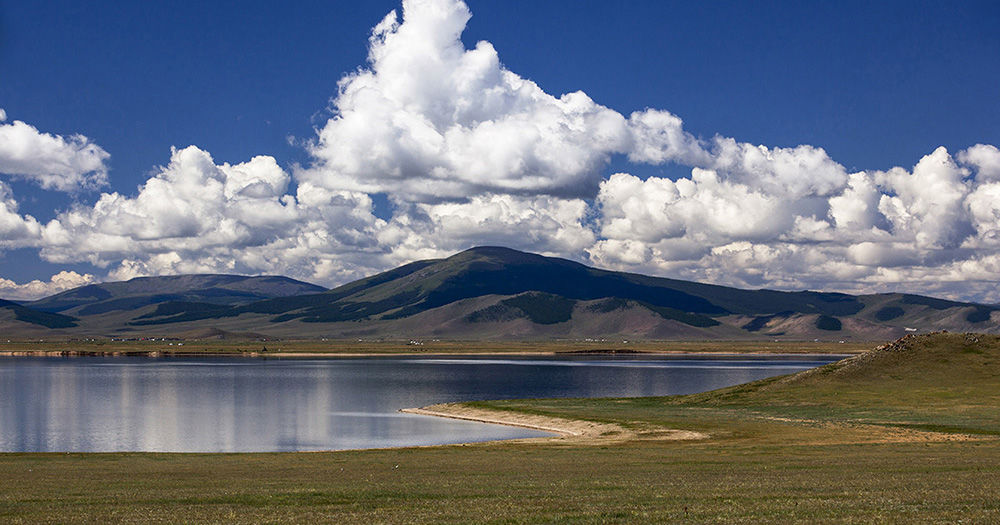
The country divides roughly into four landscapes: the Gobi Desert in the south (semi-desert, dramatic dunes, dinosaur fossils), the Khangai & Khentii mountains through the centre (rivers, larch forest, herder country), the Altai mountains in the west (glaciers, eagle hunters, Kazakh culture), and the steppe rolling across the east. The Tuul, Orkhon, Selenge and Kherlen rivers drain through this terrain to the lakes — Khövsgöl in the north is the deepest, and the world's second-oldest lake.
Climate & when to come
Mongolia has four full seasons and the swings are dramatic. Summer (June–August) is short, dry and pleasantly warm — daytime 18–28 °C across most of the country, with the Gobi pushing 35 °C. Most travelers come in this window. Naadam (11–13 July) and the late-July green steppe are the high points.
Autumn (September) is our team's favorite — golden larches, far fewer tourists, the Tsaatan taiga still accessible. Winter (November–February) is harsh — Ulaanbaatar is the coldest capital on earth — but the Ice Festival on Khövsgöl in March, the Eagle Festival in October and the Tsagaan Sar lunar new year in late January are all winter draws.
Culture & nomadic life
About 30% of Mongolians still live a fully or partly nomadic life — herding sheep, goats, horses, camels, yaks and (in the far north) reindeer. Families move 2–4 times a year between seasonal camps. The ger — the round white felt tent you see on every postcard — is genuinely home for hundreds of thousands of people.
Tibetan Buddhism is the majority religion, with strong shamanic traditions especially in the north and west. Mongolian is the official language, written today in the Cyrillic alphabet (the traditional vertical script is being revived). Russian was common a generation ago; today young Mongolians learn English, Korean and Chinese.
History — short version
The Mongol Empire was founded by Genghis Khan in 1206 and at its peak (under his grandson Kublai) covered most of Asia and a chunk of Europe — the largest contiguous land empire in history. After it fragmented, Mongolia became part of the Qing Empire (1691–1911), gained independence in 1911, and was a Soviet satellite from 1924 to 1990.
The Democratic Revolution of 1990 brought multi-party democracy, a market economy and the freedom to travel. Modern Mongolia is a parliamentary republic with a young democracy and an enormous mineral economy, sitting between two superpower neighbours.
Practical things
Visa
Citizens of 60+ countries (incl. USA, Germany, UK, France, Canada, Japan, most of EU) can enter Mongolia visa-free for 30–90 days as of 2026. Others can apply for an e-visa online or pick up a visa on arrival at Chinggis Khaan International Airport. Always check the latest rules before booking flights.
Money
The Tögrög (₮, MNT) is the local currency. Cards work in Ulaanbaatar (Visa & Mastercard); cash is needed for everything outside the capital. ATMs at the airport and in UB are reliable. USD and EUR are easy to exchange.
Language
"Sain bain uu" (sah-een bahn-oo) means hello. Our guides translate everything important. A few words go a long way with host families — your guide will teach you the essentials on day one.
Etiquette
Receive things with the right hand or both hands. Don't step on a ger threshold. Don't refuse offered food (a small taste is fine). Take off shoes when invited into a home. Walk around a sacred ovoo three times clockwise.